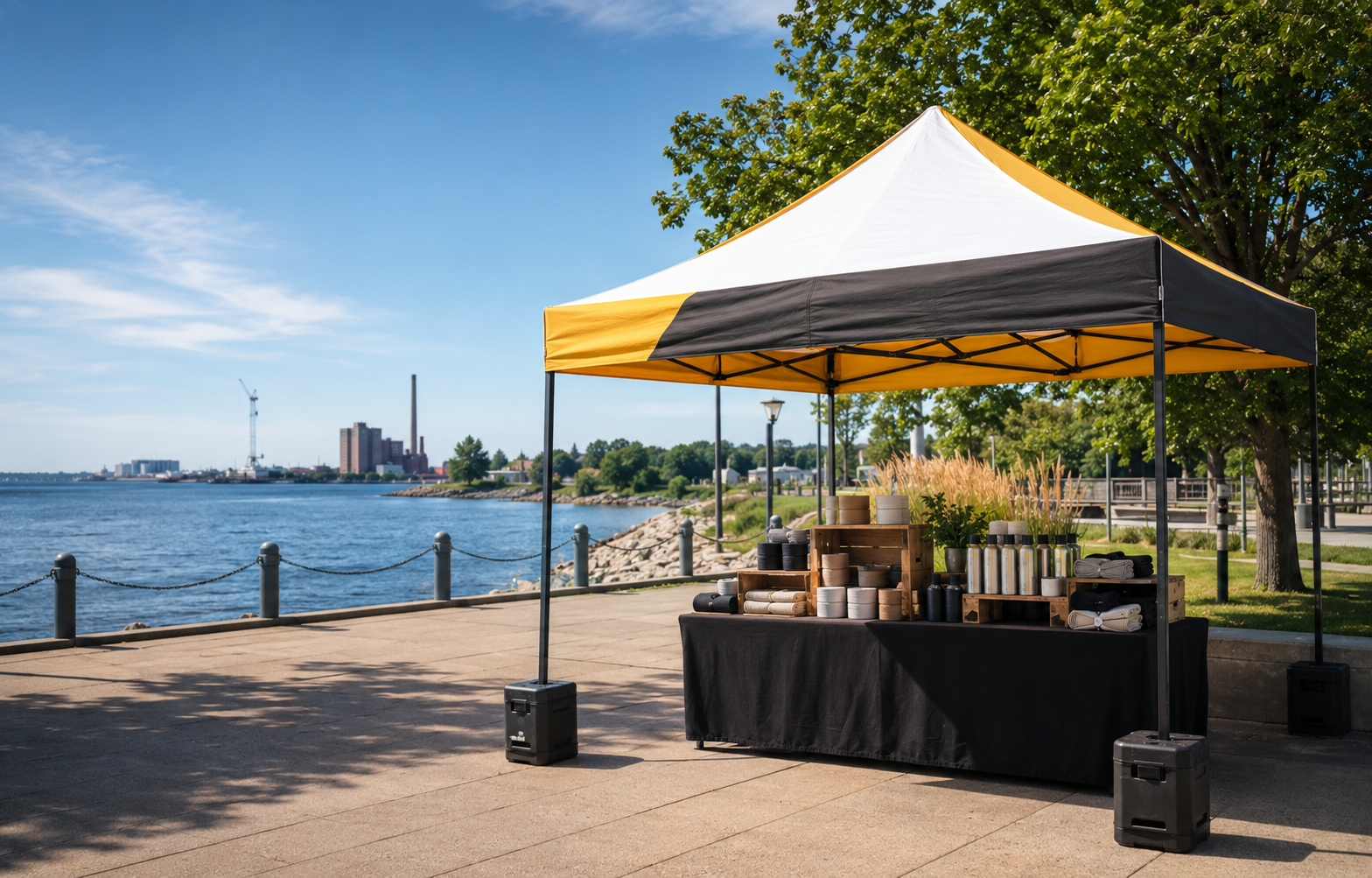
Waterfront and open parks
Bayfront Park and Pier 4 can feel more exposed than a protected street site. Use every approved anchor point, keep walls managed as conditions change, and follow the organizer’s weather plan.
Get a canopy tent built around the way Hamilton events actually work. We help vendors, businesses, teams, and organizers choose the right footprint, frame, walls, printing, and anchoring plan for markets, festivals, street activations, and repeat commercial use.
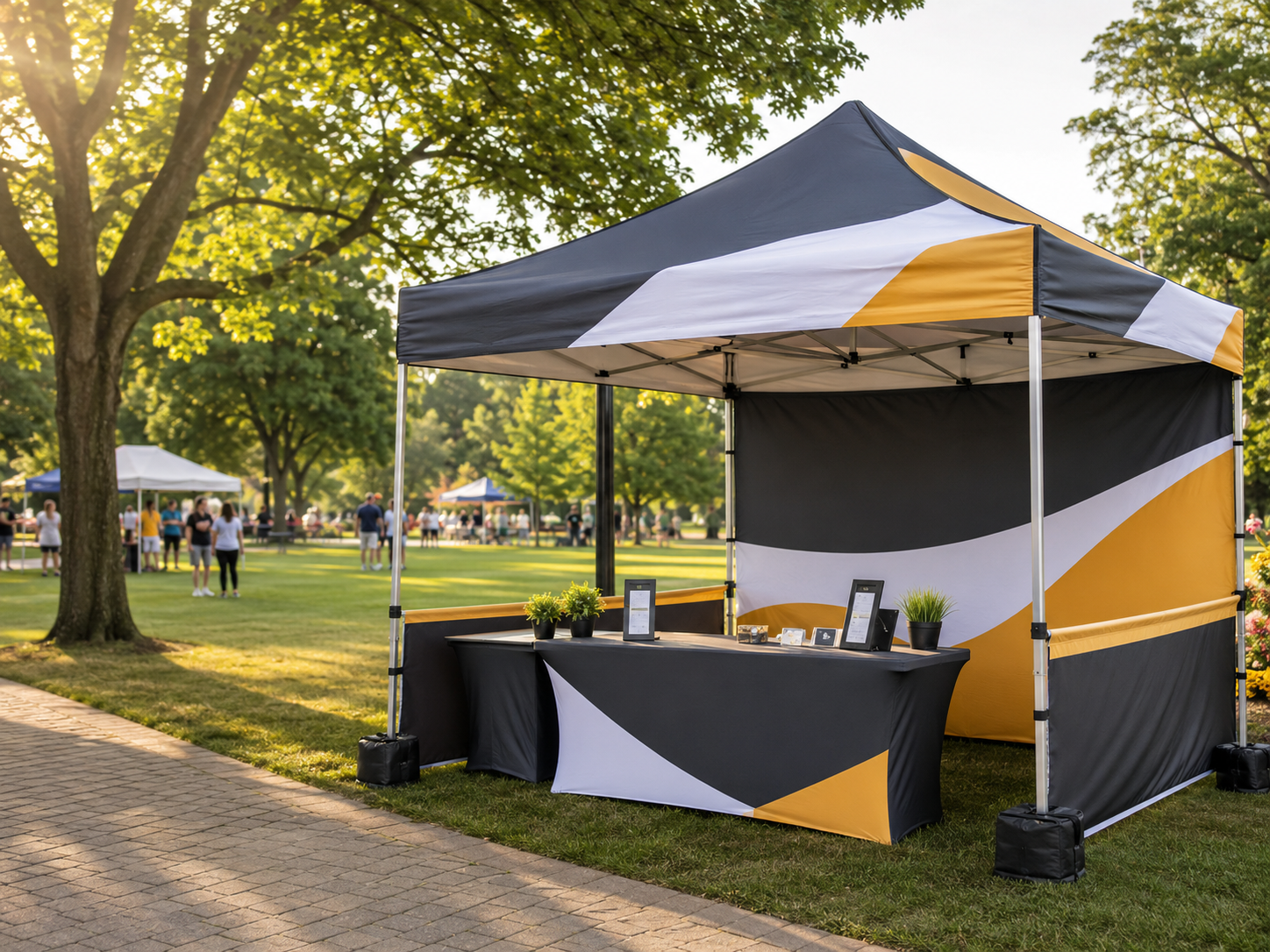
Hamilton buyers often move between very different sites: a paved James Street activation, an exposed waterfront event, a grass field in Ancaster, or a weekly market where setup speed matters. The right tent must fit the site as well as the brand.
That is why we start with four practical questions: where you will set up, how often you will use the tent, what must fit beneath it, and whether your organizer requires specific documents or anchoring methods.

Choose the smallest footprint that handles your people, stock, and workflow without making the booth feel crowded. Then match the frame grade to your actual use frequency.
| Setup | Best for | Expert note |
|---|---|---|
| 8×8 canopy | Compact displays, sampling, registration, and restricted footprints | Useful when an organizer assigns a smaller booth or sidewalk space. |
| 10×10 canopy | Market vendors, community groups, sports teams, and promotional booths | The standard one-booth footprint. It is easy to transport and gives enough room for one table plus staff. |
| 10×15 canopy | Product displays, food service workflows, and larger brand activations | Offers extra working width without doubling the footprint. |
| 10×20 canopy | Retail displays, multiple tables, vehicle promotions, and high-volume events | Plan the anchoring and transport before ordering; the larger roof creates more wind exposure. |
Our practical default: choose a 10×10 commercial-grade frame for recurring markets and activations. Move to 10×20 only when the extra space has a clear job, such as a second service point, larger inventory display, or covered customer area.
A good-looking canopy is only useful when it can be operated responsibly at the assigned venue.
Bayfront Park and Pier 4 can feel more exposed than a protected street site. Use every approved anchor point, keep walls managed as conditions change, and follow the organizer’s weather plan.
James North, King William Street, and other paved sites may not permit staking. Confirm whether weighted ballasts are required and how much space they may occupy outside the booth line.
Sites around Ancaster, Binbrook, and Flamborough may allow staking, but locates and venue approval can still apply. Never assume you may drive stakes into public land.
Hamilton has a dense mix of neighbourhood events, major festivals, markets, sports, institutions, and industrial businesses. Each needs a different booth plan.
Prioritize a clean 10×10 footprint, washable surfaces, a back wall for storage separation, and a serving layout that keeps the aisle clear. Ask the organizer about fire and food-vendor requirements before finalizing walls.
At busy events such as Supercrawl or Festival of Friends, the valance is valuable branding space because it remains visible above a crowd. Use high-contrast wording that can be understood in seconds.
For registration, fundraising, and sideline coverage, choose a portable frame, simple identification, and replaceable components. A half wall can define the booth without closing it off.
Hamilton businesses may need mobile shade, check-in, demonstrations, or recruiting setups. A heavier frame and restrained professional branding usually offer better long-term value than an entry-level retail shelter.
For sidewalk sales and neighbourhood events in Downtown Hamilton, Ottawa Street, Westdale, Dundas, or Stoney Creek, keep the tent footprint, weights, displays, and customer queue within the assigned area.
Open houses, orientation days, alumni events, and community outreach benefit from clear department identification, fast setup, and a configuration that staff can reproduce consistently.
Product guidance does not replace venue or municipal approval. Confirm requirements for your exact event and site before setup.
The City of Hamilton states that a building permit is required when one tent exceeds 60 m², or when a group of tents within 3 metres of each other exceeds 60 m². Larger event plans should be reviewed early with the appropriate City division.
Check City tent requirementsThe City’s event organizer guide says tents used by the public must be fire-retardant treated and that the certificate must be available on site if requested by Hamilton Fire. Ask what documentation comes with your canopy.
Read the organizer guideFor public events, also confirm approved anchoring, utility locates, booth boundaries, insurance, access lanes, and overnight rules directly with the organizer or venue.
A 10×10 canopy is the safest starting point because many markets and vendor events use a standard 10-foot booth. Confirm the assigned footprint before ordering, especially if weights or sidewalls must fit inside it.
Steel can provide strong value for recurring local use when transport weight is manageable. Aluminum is easier to move and resists corrosion, which can be useful for teams that travel frequently. Frame geometry, connector quality, and replacement-part availability matter as much as the material name.
Every canopy should use the anchoring method approved for its site. Paved locations commonly require weights, while some grass sites may permit stakes after approval and locates. The required ballast can vary, so follow the manufacturer and event organizer rather than using a universal number.
Sidewalls help with privacy, storage, branding, low sun, and directional rain. They also catch more wind. Choose removable walls and be ready to open or remove them when the organizer or weather conditions require it.
Yes. Hamilton-area orders can serve Downtown Hamilton, the Mountain, Ancaster, Dundas, Stoney Creek, Waterdown, Flamborough, Binbrook, and surrounding communities. Provide the complete delivery address when requesting a quote.
Share the tent size, stock or custom requirement, artwork status, number of walls, frame-use frequency, delivery postal code, event date, and any organizer specifications. Photos or a vendor manual can prevent incorrect assumptions.
Tell us where you plan to use the tent, how often it will be set up, what must fit underneath, and what the event organizer requires. We will help you compare the footprint, frame, printing, walls, and accessories as one working system.